Roma are one of the most discriminated and marginalized ethnicities in Europe. Across the continent, almost 12 million Roma face barriers to basic human rights, as well as hate speech and racism. This is also true in Ukraine, where Roma communities often have limited access to education, healthcare, and employment.
On International Roma Day, Oxfam’s partner organization in Ukraine, Voice of Romni, sheds light on the realities behind these numbers and shares what it takes to build trust with Roma communities in a context shaped by war, exclusion, and systemic barriers.
Polina never imagined she would work with Roma communities. In her hometown of Melitopol in southern Ukraine, she ran a flower business. But when the city was occupied, Polina and her husband were forced to flee and leave everything behind. In their new city, Zaporizhzhia, she began volunteering and met the people from Voice of Romni (VoR).
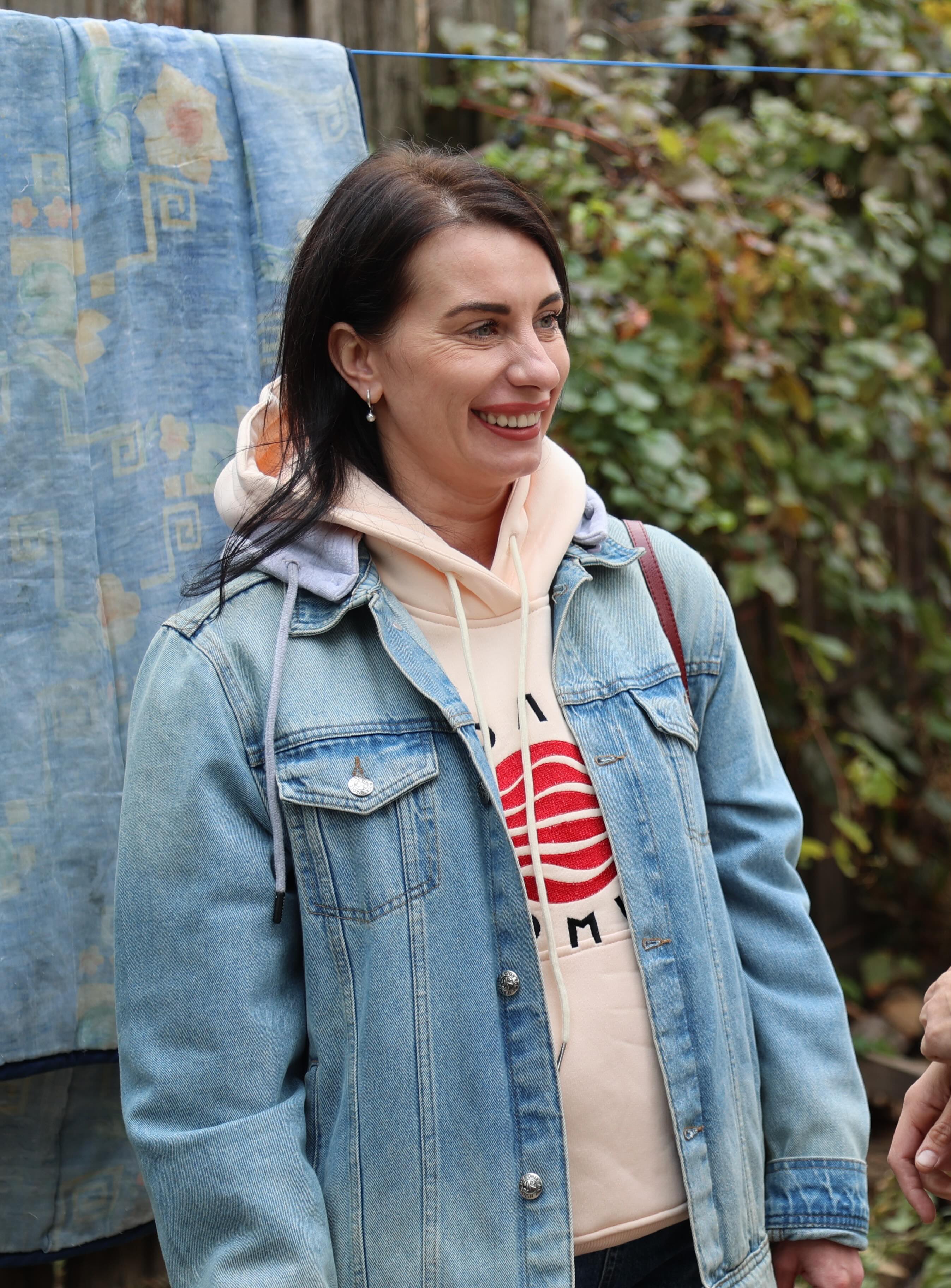
Polina Borshch, former Regional Coordinator for Voice of Romni in Zaporizhzhia. (Photo courtesy of Voice of Romni)
“One of the volunteers asked if I could help distribute bread to Roma families. I was lonely and in need of work, so I said yes. But I was worried. I heard many stereotypes,” recalls Polina, the former Regional Coordinator for Voice of Romni.
Polina was not alone in these assumptions. Her husband and friends were surprised she chose to work with Roma communities. Research published by VoR in 2024 shows that prejudice remains widespread: parents protest when Roma children attend schools alongside their own, Roma experience discrimination while lining for humanitarian aid, and are often denied jobs because of their nationality or skin color.
“Sometimes Roma pretend to be Romanian or Turkish just to get a job,” adds Anzhelika Bielova, Head of Voice of Romni.
Discrimination is not the only barrier Roma face. Although up to 400,000 Roma are estimated to live in Ukraine, many remain invisible to state systems. According to UNHCR, 45% of people in Ukraine who lack identification documents and need nationality confirmation are Roma. Some are unaware of the process, some do not speak the language, and others simply cannot afford it. Without documentation, access to education, healthcare, and formal employment becomes nearly impossible.
Because of this long history of exclusion, Roma people are often cautious when engaging with people not from their community. Polina says it took her team nearly three years to build trust with the community in Zaporizhzhia oblast.
They were not very open or talkative at first. But every week we returned to the village, bringing support for families and their children. Over time, I got to know almost everyone — around 1,000 people. After that we trusted each other completely. I understood how Roma live and what they need.
Voice of Romni provides humanitarian assistance, repairs homes, and supports the education of Roma children across Ukraine, including those displaced to western regions. As the humanitarian response has evolved, more and more international actors are prioritising assistance to people closest to the front lines. However, without sufficient support in safer areas, some families feel compelled to return to dangerous locations, VoR explains.
A big part of their work is economic empowerment, especially for women. In many Roma communities, women are expected to take on all household responsibilities and care for the children. At the same time many also take on hard, physically demanding jobs to support their families. This leaves little room for learning or personal development.
A few years ago, we met a 17-year-old Roma girl, Karolina (name changed), who used to come with her elderly father to collect humanitarian aid. She would carry 10-kilogram boxes to the car on her own. We often asked if there was an adult who could help her. But her mother was working, and she had a younger sister, so she was considered the adult in the family.
Karolina became actively involved in VoR’s activities. Through their educational events, she learned computer skills and improved her Ukrainian. But as soon as she turned 18, she started working as a cashier to help out her family and visited less often. The VoR team invited Karolina back — this time as a staff member. She was trained to be a gender-based violence (GBV) case manager.
Roma women share things with her they would never tell us. It’s still a taboo topic. I can’t even offer shelters for survivors of violence. Many are afraid the perpetrator will find them and hurt them. Still, we are moving forward in small steps.
VoR works actively to empower women through job training, small grants and support for individual projects, such as educational films about Romani history or small businesses. An important part of this approach is having Roma women on the team — they are engaged through leadership programs, gaining skills and experience that allow them to take active roles in supporting their communities. Polina says their ultimate goal is to make women believe they can do anything they want.
“Last year, Karolina invited me to her wedding with a non-Roma man. Her family were really shy, but I took out the Roma flag and encouraged them to sing Romani songs. It was incredible!
“Karolina cried and said she had never imagined being supported like this, without experience or a background in any organization. I told her, ‘All of us started without experience.’ Sometimes, we need to work really hard to see humanity in people, not their ethnicity, religion, or labels that have been imposed for centuries.”

Anzhelika Bielova at the Voice of Romni office in Uzhhorod. (Photo: Alona Malashyna/Oxfam)
For Anzhelika, who grew up in the community facing discrimination herself, stories like Polina’s reflect the kind of trust that is necessary, the willingness to move beyond assumptions, and learning directly from those they serve so they can better support Roma communities.
Because I am from the Roma community, I know how challenging it can be, and this is why it is so important for our team, including non-Roma staff, to stay close to the people, to be in constant contact, to understand where they are coming from and what problems they face. This is the main thing.