
On this page:
Today, civilians are being targeted, food and water are being weaponised, schools and hospitals are being bombed, and humanitarian aid is deliberately blocked. Every day, world leaders and corporations choose power, profit and political interests over human lives. They normalise the unacceptable, ignore the suffering of civilians, and enable attacks that strip people of their dignity, safety and future. If you believe this is wrong, if you believe our shared humanity demands better, then your voice matters now more than ever.
You’re about to become part of a vital campaign to challenge the blatant breaches of international humanitarian law which are being normalised by unscrupulous world leaders and corporations. It’s time to hold the lawbreakers to account. To reclaim the basic standards that protect us all. It’s time to end these attacks on humanity.
Joins Us: Just Be Human
A Changing Global Power Landscape
The global landscape is shifting rapidly, with major powers increasingly willing to act outside long-standing diplomatic norms and international legal frameworks. In recent years, the United States has adopted a more unilateral and power-driven foreign policy, which has weakened pressure on states to uphold International Humanitarian Law and the UN Charter. This retreat from multilateralism is mirrored elsewhere and has emboldened leaders who now pursue strategic and territorial ambitions with far less fear of accountability.
Resurgent Imperial Dynamics and Rising Tensions
Across regions, from the Middle East and Southwest Asia to Latin America and the Arctic, assertive actions by powerful states are signaling a resurgence of imperial-style politics. These dynamics are intensified by growing competition for natural resources such as rare earth minerals. At the same time, the Atlantic alliance is under strain, while China and Russia are asserting their influence with increasing confidence. The risk of escalation is real, with Taiwan often cited as a potential flashpoint and autocratic leaders increasingly willing to use force or the threat of force to achieve their objectives.

Hiba teaches her children inside their tent in Al Mawasi, Gaza. Oxfam, as part of the “We Rise” consortium, has been working together with two national partners in the West Bank and Gaza, enhancing prevention of and protection from violence and human rights violations, increasing meaningful participation of women, girls, and women’s rights organizations in decision-making processes, and strengthening accountability for the rights of women and girls nationally and internationally. (Photo: Alef Multimedia/Oxfam)
Escalating Conflicts and Deepening Inequalities
These geopolitical shifts are unfolding alongside a rise in the number and intensity of armed conflicts. One in seven people globally now lives amid violence, yet crises in Sudan, Yemen and Mali continue largely out of view while the world focuses on Ukraine and Gaza. Conflict is reinforced by widening racial, gender and economic inequalities, climate breakdown, extractive economic systems and deepening impunity. As international law is applied inconsistently, efforts by African and Latin American states to assert their rights through bodies like the International Criminal Court or the Hague Group risk being undermined.

Balancing the heavy water container on her head, Abeer begins the long journey home. In Yemen, a decade-long war has caused one of the world's most serious humanitarian crises, affecting more than half of the population. The conflict has collapsed basic infrastructure such as healthcare, housing and, especially, access to drinking water. (Photo: Ahmed Albasha/Oxfam)
Shrinking Civic Space and Expanding Influence of Non-Western Powers
Aid budgets are shrinking and becoming more conditional, further limiting the space for civil society to operate. At the same time, China and the Gulf states are expanding their influence, particularly in Africa, often with limited regard for human rights or environmental protections. Around the world, civic space is closing at an alarming pace. Only a small minority of the global population now lives in open or relatively open civic space, and activists and human rights defenders face increasing levels of criminalization and attack.
Humanitarian Consequences Beyond the Battlefield
In many contexts, humanitarian crises deepen even where fighting has not yet begun. The denial of rights and long-term injustices increases hardship and creates grievances that can trigger future violence. Our partners remind us that beyond the immediate destruction of war, the most lethal forces are often hunger, disease and destitution.
A Call for Solidarity and Accountability
Many people, both within affected communities and in donor countries, feel overwhelmed and powerless in the face of these converging crises. Yet positive change remains possible. This campaign aims to expose those who fuel conflict or exploit vulnerable communities and to challenge the growing culture of impunity. Above all, it seeks to stand in solidarity with people on the front lines as they demand protection, justice and accountability. At a time when the world risks sliding into hardened divisions and zero-sum politics, we choose to defend our shared humanity. We reject a future shaped by oppression, self-interest and the rule of brute force.
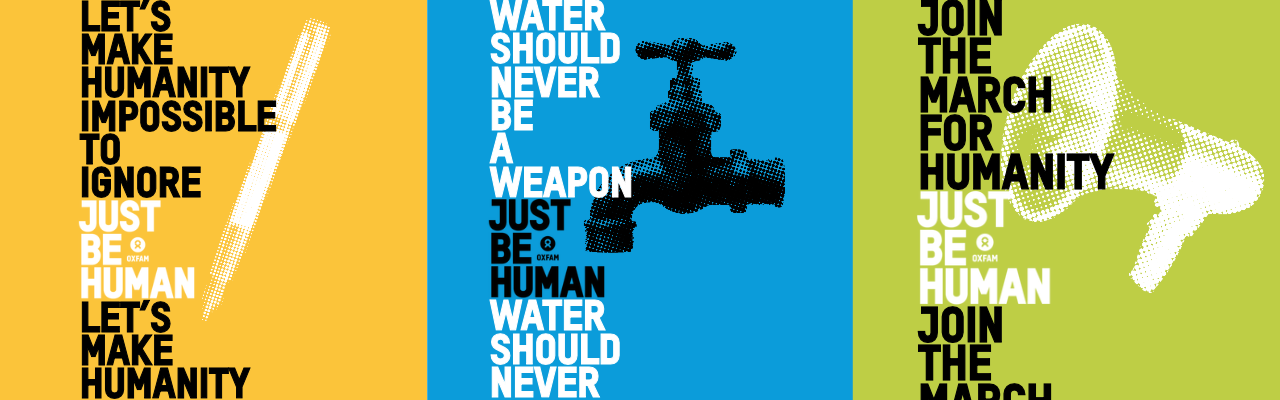
Our Campaign Manifesto
Targeting civilians.
Cutting off food and water supplies.
Bombing schools and hospitals.
Deliberately blocking humanitarian aid.
These illegal acts - prohibited by international law - are now everyday facts of life.
They’re being normalized, enabled or ignored by world leaders
and corporations obsessed with power, profit and self-interest.
Who prevent peace-building and use war as foreign policy.
Who see people as collateral damage, not as human beings.
It isn’t right.
It isn’t legal.
It isn’t human.
And enough is enough.
It’s time to end these attacks on humanity.
To hold the lawbreakers and their enablers to account.
To reclaim the basic standards that protect us all.
Join the movement calling out illegal acts of aggression.
Giving what we can to protect civilians in conflict and crisis.
Speaking out together to defend humanity everywhere.
We have just one demand:
END THE ATTACKS ON HUMANITY.
JUST BE HUMAN.
Our Four Strategic Goals
We drive collective action and solidarity, connecting communities and movements to challenge systems and actors that profit from and perpetuate war and oppression. With our advocacy, we hold the powerful to account, enabling and facilitating collective action to ensure people’s rights are upheld in crises. Guided by a commitment to humanity, we work alongside communities – including civil society and activists – to strengthen their agency, protect their rights, and co-create sustainable solutions.
By challenging the social, political, and economic choices that drive and perpetuate crises, we create space for marginalized people and communities affected by crises to claim their rights, hold the powerful to account, and enjoy a more just, equitable, and humane future.
We enable pathways, local to global, by protecting civilians, everywhere, challenging impunity, fighting against powerful men making profits from conflicts, and calling out states vetoing justice and hijacking global peace.
We refuse a world where civilians are bearing the brunt of conflicts. We call on decision-makers to place the protection of civilians at the centre of all policies and interventions in conflict settings by strengthening and defending international legal frameworks, ensuring renewed adherence to International Humanitarian Law, and championing principled, gender‑just humanitarian action that is free from political or military conditions. We denounce the current global politicisation and reduction of aid and refuse decisions to condition aid to political or military objectives, calling out the double standards which lead donors to prioritise funding crises based on political interest rather than the needs of communities.
READ MORE & SUPPORT OUR COUNTRY TEAMS:
We refuse a world where wealth fuels war. We act to pressure powerful, wealthy men, as well as governments, investors and financial institutions, to stop profiting from war and violence, selling arms to rights violators. We call on them to limit military spending to the detriment of the protection of civilians and aid. We push for investments in conflict prevention and aid for civilians caught in the crossfire. Deep cuts to humanitarian aid mean communities have fewer resources to save lives, to prevent disease and feed their families. Medicines, schools and food should not be cut off to pay for bombs and bullets. We cannot accept a world where wealth fuels war and conflict becomes a playground market for powerful men.
READ MORE & JOIN OUR CAMPAIGNS:
The level of impunity we are witnessing today is threatening our common humanity to its core: it’s a humanitarian crisis in itself. We call for universal respect for norms that safeguard humanity and demand accountability for their violations. We expose the manipulation of the system by self-interested, powerful leaders, directly responsible for failing to prevent breaches or double standards in applying international norms, international humanitarian law (IHL) and the UN Charter. We want to build a movement that fights for the principles of humanity and solidarity, and claims that the benefit of upholding them outweighs the cost of failing to do so.
READ MORE & JOIN OUR CAMPAIGNS:
- Stop Trade with Settlements
- Speak Up For Palestine
- Not In My Name
- IHL in Focus reports
We refuse a world where power can veto humanity. We challenge the current global governance mechanisms that perpetuate oppression and injustice. Fight against the growing imperial ambitions of major powers and to replace the increasingly moribund current arrangements. Support our call for reformed, decolonial, just, global governance mechanisms and for a peace and security system that works for people, not power.
READ MORE:
- Vetoing Humanity: How a few powerful nations hijacked global peace and why reform is needed at the UN Security Council.
- No Representation, No Peace: The African demand for a reformed Security Council.
- Voices from the Frontline: Messages for the next UN Secretary General